
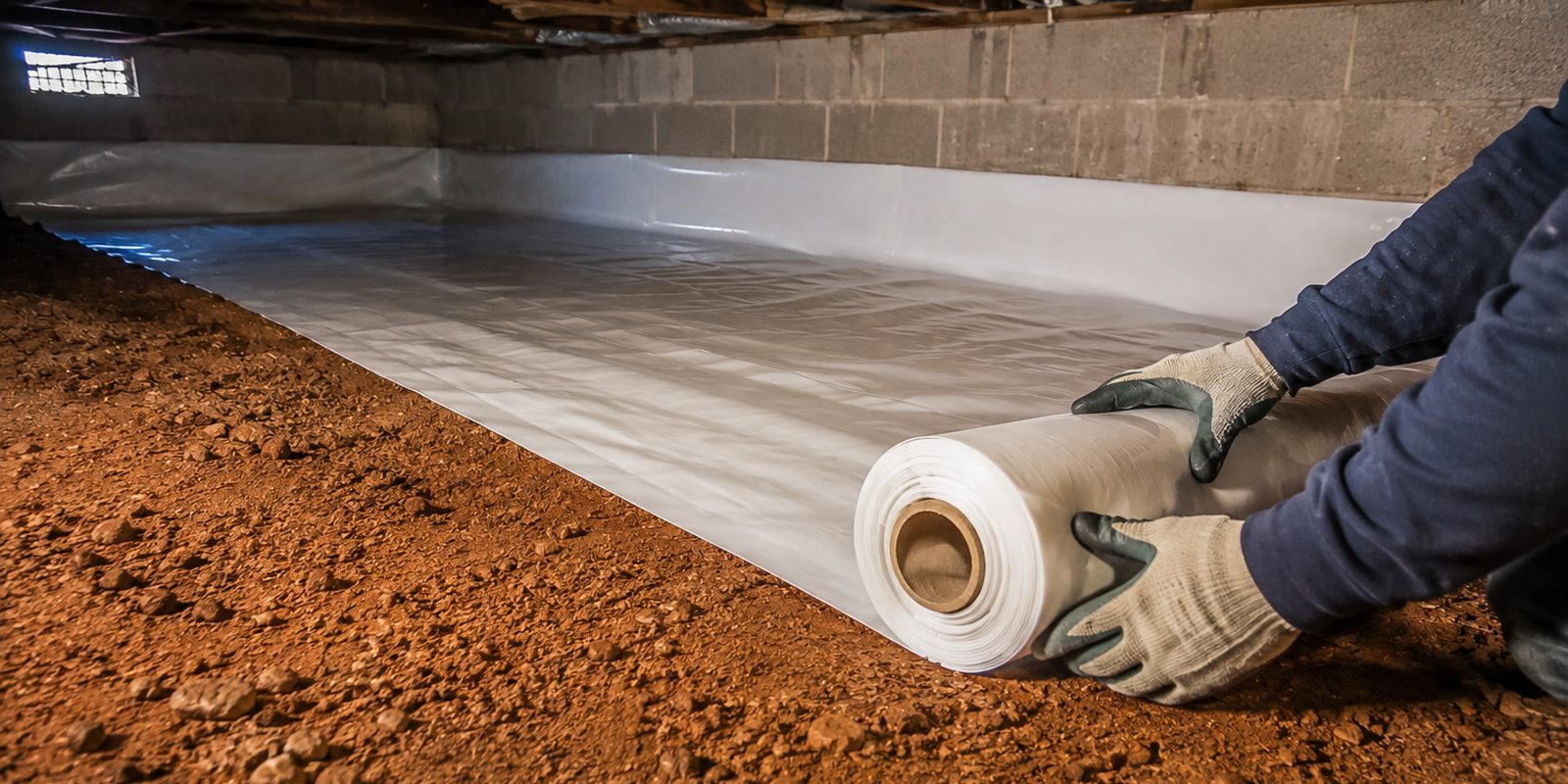
A vapor barrier is a sheet of polyethylene across the crawl space floor that stops moisture evaporating out of the soil and into the air under your house. It is the cheapest meaningful improvement most crawl spaces can have, and it is also the one most often done badly.
How Much Moisture the Ground Gives Off
More than people expect. Bare soil under a house can release several gallons of water a day into the crawl space air through evaporation. That is the largest single moisture source in most unlined crawl spaces, larger than any leak.
Covering it stops that at source, which is why a liner earns its money even before you get to sealing vents or running a dehumidifier.
What Separates a Real One From a Token One
Thickness. Builders’ plastic at six mil tears the first time somebody crawls across it to service the ductwork, and a torn barrier is not a barrier. Twelve to twenty mil reinforced liner survives being worked on.
Sealed seams. Overlapped sheets left loose leak at every joint. Seams need overlapping generously and taping with a tape rated for the job.
Wall termination. The liner should run up the foundation walls and be mechanically fastened near the top, not stopped at the floor edge. Moisture rises through block walls too.
Piers wrapped. Every pier is a gap in the barrier unless it is cut around and sealed.
Barrier Alone, or Full Encapsulation?
A liner on its own, with vents left open, still helps considerably — it removes the ground as a moisture source. For a crawl space that is basically dry and just a bit damp, it may be all you need.
Full encapsulation adds sealed vents, wall insulation and a dehumidifier, and is the right answer where humidity is high, wood moisture is elevated, or there is already decay. In this climate that is most houses, but not all, and the honest answer depends on what the meter says.
What a liner cannot do is cope with liquid water. If the crawl space floods, the barrier traps water against the ground and holds it there. Drainage first.
Cost
A properly specified and sealed liner typically runs from around $1,500 to $4,000 for an average Huntsville crawl space, depending on square footage, clearance and how much debris has to come out first.
If a quote comes in far below that, ask what thickness is being used and whether the seams are taped and the walls terminated. That is usually where the difference is.